
Interoperable SIP transport
Connect MonsterPBX, Asterisk, FreePBX, or any standard SIP PBX over WSS/WS, TCP, or UDP.

Enterprise SIP Softphone
MonsterSIP is the suite’s voice client for everyday desktop, mobile, and tablet operations. It provides quick MonsterPBX provisioning, background calling, a corporate directory, local history, and explicit audio-device selection.
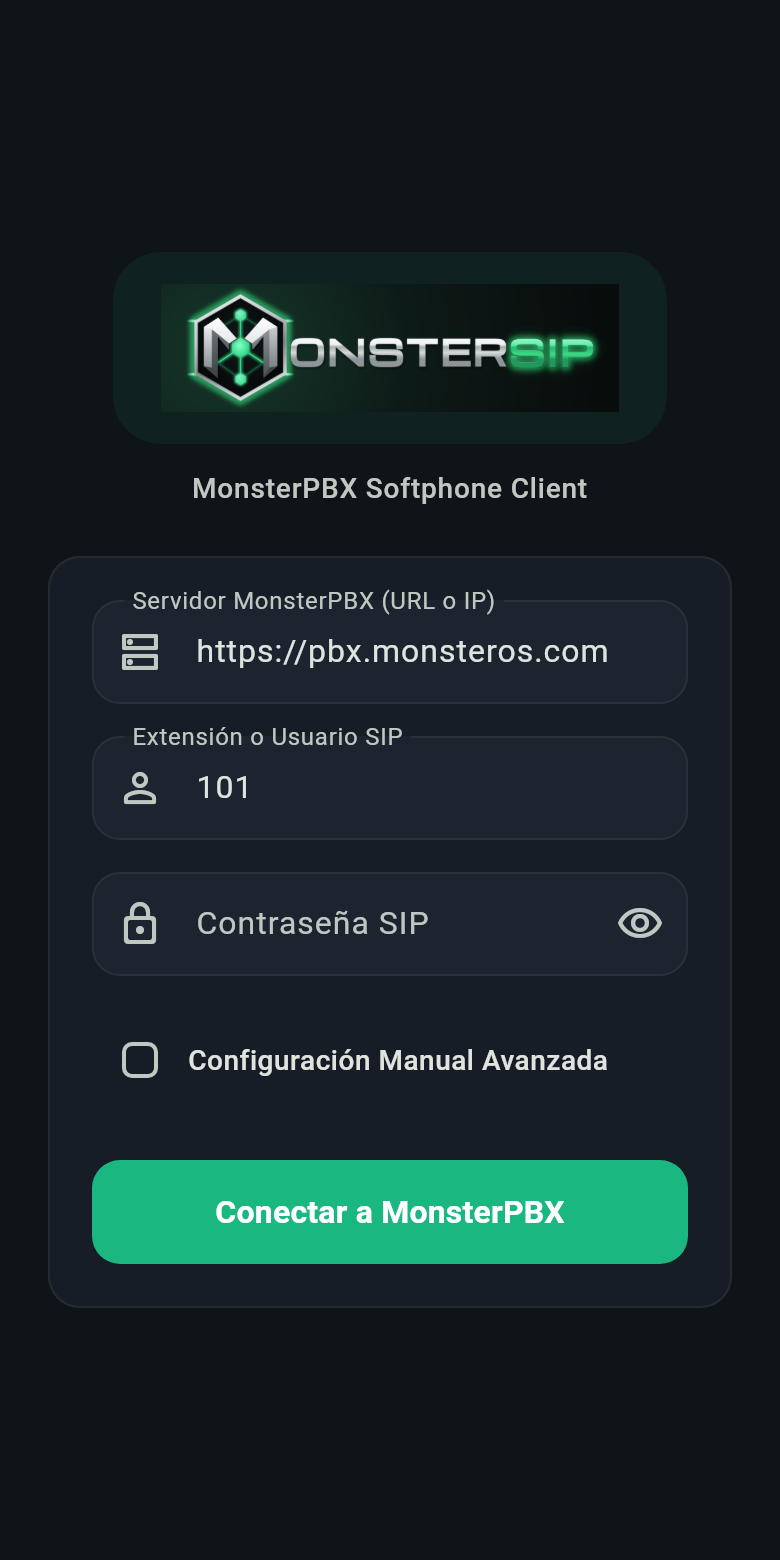
MonsterSIP · 1.0.0
The same SIP account with native controls for Android and Linux.
Platform
View
Android
Keep signaling available while users change networks, lock the screen, or minimize the app.
Android combines full-screen incoming calls, a keepalive service, network recovery, and proximity sensing. Linux uses tray controls, D-Bus notifications, and sip:/tel: handlers.
Android · SIP connection
Connect MonsterPBX, Asterisk, FreePBX, or any standard SIP PBX over WSS/WS, TCP, or UDP.
Receive the full SIP profile, STUN/TURN, transport, and directory from a server URL.
Receive calls with the screen locked on Android and from the Linux system tray.
Choose microphone, output, Bluetooth, USB, or headset audio for each user environment.
Sync the MonsterPBX directory and keep the last 100 records in local SQLite.
SIP credentials and Android contacts stay on the device under explicit consent.
Suite integration
Provisioned from MonsterPBX with a corporate directory and local call history for daily operations.
MonsterSIP · architecture
Interoperable SIP transport, background continuity, and local audio and privacy controls.
Connect MonsterSIP to MonsterPBX, Asterisk, FreePBX, or any standard SIP PBX.
WebRTC over WSS/WS uses DTLS-SRTP with Opus and G.711. TCP/UDP uses Plain-RTP with G.711 and RFC 2833 or SIP INFO DTMF.
Provision the SIP account, transport, and corporate directory from one server URL.
Quick mode receives username, domain, wsUri, STUN/TURN, transport, SIP port, and auto-answer from /api/v1/auth/provision.
Keep signaling available while users change networks, lock the screen, or minimize the app.
Android combines full-screen incoming calls, a keepalive service, network recovery, and proximity sensing. Linux uses tray controls, D-Bus notifications, and sip:/tel: handlers.
Control audio devices and keep credentials and call history on the user’s device.
SIP credentials are stored encrypted. Call history uses local SQLite, and the audio selector lets users check input levels before calling.
MonsterSIP · platforms
Choose the environment that fits each workstation, device, and IT policy.
MonsterSIP · distribution
Packages for Linux desktops and Android devices managed by your team.
Softphone for Android 7.0 or later with locked-screen incoming-call handling.
Debian/Ubuntu package for 64-bit Linux desktops.
Portable distribution that runs without an administrative installation.
The iOS version is planned, but no download package has been published yet.
MonsterSIP · deployment
Ports and flows your IT team can validate before deployment.
Service
SIP signaling over WebSocket
Protocol
TCP
Port
8089 (wss://)
Notes
Configurable manually or through provisioning.
Service
Classic SIP signaling
Protocol
TCP / UDP
Port
5060
Notes
Configurable per SIP account.
Service
MonsterPBX API
Protocol
HTTPS
Port
443
Notes
Provisioning and corporate directory.
Service
RTP / WebRTC media
Protocol
UDP
Port
Local ephemeral
Notes
The PBX defines the remote RTP range.
Service
NAT traversal
Protocol
UDP / TCP
Port
3478 or 19302
Notes
STUN/TURN depends on the configured server.
Validate ports and RTP ranges with your IT team before activating a production account.
Pair this module with the rest of the suite for end-to-end operations.

CRM & Revenue Operations
Manage sales pipelines, unified customer timelines, logged calls, and workflow automations without switching tools.

Cloud IP-PBX & Call Routing
Orchestrate SIP and WebRTC extensions, multi-tier IVR trees, smart queues, schedules, and call recording from one clean web console.